
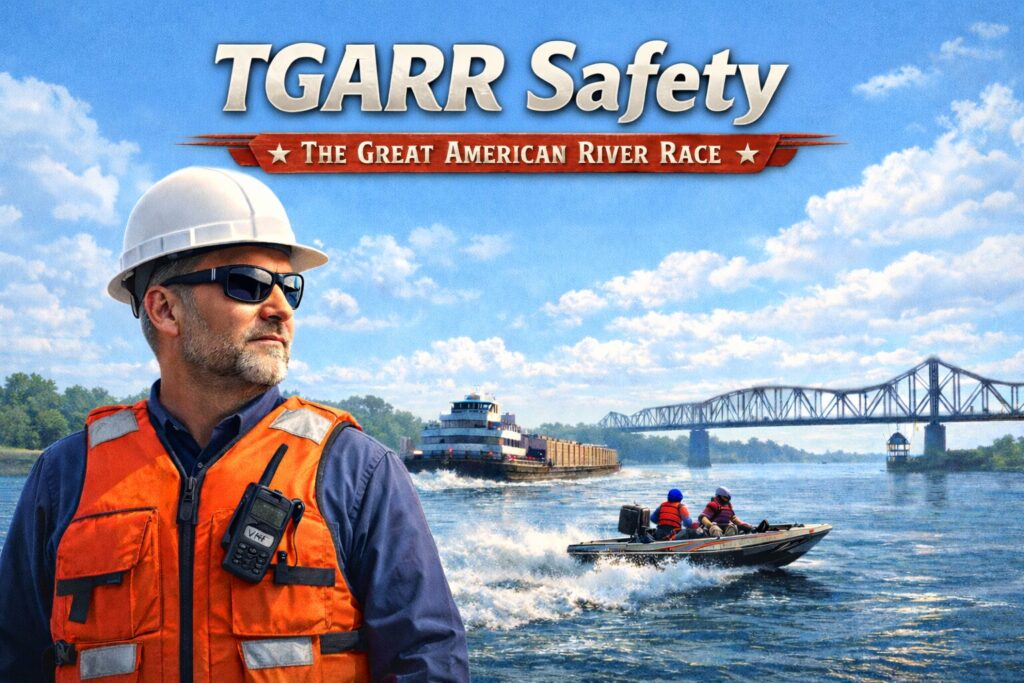
TGARR Safety Plan
The Great American River Race
The Great American River Race (TGARR) is a long-distance endurance challenge conducted on a working river. Safety is a shared responsibility between race organizers and each participating team. This Safety Plan outlines the expectations, requirements, and principles that govern how TGARR is run.
TGARR is not a closed course and not a supported event. Teams operate on public waterways, under existing laws, and must be prepared to manage risk, fatigue, mechanical issues, and changing river conditions.
1. Safety Philosophy
TGARR is built on a simple principle:
Every team is responsible for the safety of its boat, crew, and decisions at all times.
The organizers set minimum standards and expectations, but no rule, inspection, or communication replaces good judgment. Teams must be conservative in their decisions and prioritize safety over speed, standings, or pride.
If conditions are unsafe—mechanically, medically, or environmentally—teams are expected to stop, rest, repair, or withdraw.
2. Public Waterway Reality
- TGARR takes place on the Mississippi River, an active commercial waterway
- Expect:
- Commercial barge and tow traffic
- Recreational vessels
- Changing currents, debris, wakes, and water levels
- No part of the river is reserved or controlled for TGARR
Commercial traffic always has the right of way.
3. Required Safety Equipment (Minimum)
All boats must carry and use, at a minimum:
- USCG-approved life jackets for every person onboard
- Throwable flotation device
- Fire extinguisher
- Navigation lights (functional for night operation)
- Sound signaling device (horn or whistle)
- First-aid kit
- Anchor with sufficient line
- Bilge pump or equivalent dewatering method
- Emergency signaling capability (cell phone, marine radio, or satellite device)
- Basic tool kit and spare parts appropriate to the boat
Additional safety equipment may be recommended or required prior to race start.
4. Crew Readiness & Fitness
Each team is responsible for ensuring:
- All crew members are physically capable of extended operation, heat exposure, vibration, and fatigue
- At least one crew member is capable of basic first aid
- Crew members understand:
- Night navigation
- Barge interaction
- Emergency procedures
- Alcohol or impairing substances are strictly prohibited while underway
Fatigue management is critical. Teams are expected to plan for rest, rotation, and recovery.
5. Navigation & Operating Rules
- All teams must comply with:
- U.S. Coast Guard regulations
- State and local boating laws
- Navigation rules (COLREGS)
- Safe speed is mandatory at all times
- Reckless operation, wake harassment, or unsafe passing will result in penalties or disqualification
- Night operation is permitted only with:
- Functional navigation lights
- Alert, rested crew
- Conservative speed and spacing
6. Weather & River Conditions
- TGARR runs rain or shine
- Teams are responsible for monitoring:
- Weather forecasts
- River stage and flow
- Severe weather warnings
- In the event of:
- Severe storms
- Extreme winds
- Unsafe visibility
Teams must stop and seek safe harbor
The race clock does not override safety decisions.
7. Mechanical Failures & Breakdowns
Mechanical issues are expected.
- Teams must be self-sufficient
- Repairs may be made:
- Anchored outside of navigation channels
- On shore
- At marinas
- At public landings
- If a vessel becomes disabled in a navigation channel:
- Move clear of traffic immediately if possible
- Signal distress if required
- Contact local authorities if safety is compromised
8. Emergencies & Medical Events
In any emergency:
- Stabilize the situation
- Ensure crew safety
- Contact emergency services if required (911 / Coast Guard / local authorities)
- Notify race organizers as soon as practical
Race organizers are not first responders and may not be immediately available.
9. Race Monitoring & Communications
- TGARR may use GPS tracking for:
- Safety awareness
- Race integrity
- Tracking is not a rescue system
- Teams must maintain their own communication capability at all times
10. Withdrawal & Assistance
Any team may withdraw at any time for any reason.
- Withdrawing is not a failure
- Accepting outside assistance for safety or recovery is always permitted
- Assistance may impact race classification but never safety decisions
11. Enforcement & Penalties
Unsafe behavior may result in:
- Time penalties
- Forced stoppage
- Disqualification
- Removal from the event
Organizers reserve the right to intervene if a team’s actions pose a risk to themselves or others.
12. Final Word
TGARR is a test of endurance, ingenuity, and judgment—not recklessness.
Respect the river.
Respect commercial traffic.
Respect your limits.
If it feels unsafe, it probably is. Stop.