
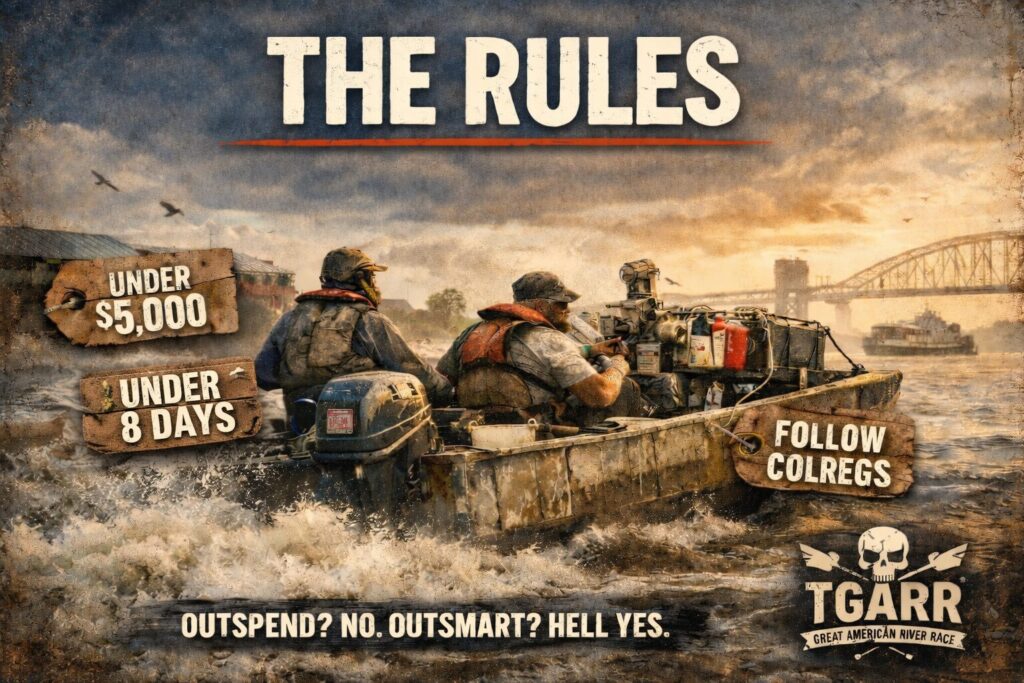
As Walter Sobchak would say – this is not ‘Nam, this is TGARR. There are rules.
This page outlines the official rules and regulations for participants of The Great American River Race, providing detailed guidelines for team eligibility, boat requirements, and competition.
The Great American River Race is about adventure, ingenuity, and seeing how far a questionable idea can go when backed by preparation and grit. But let’s be clear: this is still a race, and races need rules to keep things fair, safe, and at least somewhat sane.
Once the race begins, enforcement is real, judgment is final, and accountability is expected.
General Conduct
Spirit of the Race: This is a budget race, not a rich-man’s regatta. Play fair. Anyone caught flagrantly cheating risks disqualification and eternal mockery.
Safety First: The race is for fun, not funerals. Failure to carry proper safety gear = automatic DQ.
Respect the River: Follow navigation laws, be courteous to commercial traffic, and don’t destroy the waterways.
Rulings: The judges are the final word on all qualifications, disputes, penalties, etc. There are no appeals.
Budget Cap – $5,000 that’s it.
Boats must be acquired and prepared for no more than $5,000 total. No Rationalizations:
- “It should be worth $5,000” → Nope.
- “It was worth $5,000 before I dropped another $4,000 fixing it” → Nope.
- “I’ve owned it 20 years, so it doesn’t count” → Nice try, still nope.
Five thousand dollars means five thousand dollars. Period.
Parts & Equipment
Parts Cost: “Free” parts, buddy donations, leftovers from your garage, or items “lying around” still count toward your $5,000 budget. The price is what the last real buyer actually paid, or what the judges determine it to be worth. Don’t get clever.
Registration, Insurance & Safety:
All boats must be legally registered, insured, and fully compliant with U.S. Coast Guard (USCG) and all applicable local, state, and federal regulations for the waters they will navigate.
These requirements do not count toward the $5,000 build budget.
Required safety equipment does not count toward the $5,000 cap.
This includes (but is not limited to):
- Life jackets / personal flotation devices (PFDs)
- Fire extinguishers
- Navigation lights
- Anchors and anchor lines
- VHF radios
- Flares and visual distress signals
- Bilge pumps
Safety equipment is defined strictly as gear intended to protect life and prevent emergencies.
This exemption exists to encourage safe boats—not creative accounting. Items that provide comfort, performance, redundancy beyond reason, or competitive advantage will not be considered safety equipment. Remember, the judges are the final word, so ask if you are in doubt.
Labor & Sponsorship
Labor: Free labor is free. Paid labor counts toward your budget. End of discussion. No creative interpretations. No “friend rates.”
Sponsorships: Got a sponsor to give you cash or parts? Nice hustle. Still counts toward the $5,000.
That said, sponsor money may be used for off-boat expenses such as: Hotels, fuel, entry fees, marina fees, pedicures, matching swimsuits, other questionable but non-boat-related priorities
Spend it wisely interestingly!
Net Budgeting – Buy, Sell & Swap
Scavenger Sales: If you sell parts of your boat, the cash you earn can offset your budget.
Note: Be ready to prove every transaction to judges who will assume you’re lying until proven otherwise.
Race Duration
The Great American River Race is a test of endurance, judgment, and efficiency—not an endless slog.
Total race time is capped at 8 days (192 hours).
The clock starts at the official race launch in St. Paul, Minnesota and runs continuously until a team reaches the official finish at Dauphin Island in the Gulf. Time does not stop for weather, mechanical failures, rest, repairs, or bad decisions.
Teams may choose when and how to run—day or night, fast or slow—but once the clock starts, it keeps ticking. Any team that has not reached the finish within 8 days will be recorded as DNF (Did Not Finish).
This time cap exists for three reasons:
- To reinforce that TGARR is about smart decisions, not just raw endurance
- To reward reliability, efficiency, and adaptability
- To ensure the race remains competitive, fair, and logistically manageable
There are no extensions. There are no pauses. There are no exceptions. Just the river, the clock, and how well you planned for what you didn’t plan for.
Pre-Race Inspection
All boats will be inspected by the Panel of Judges prior to the race to verify budget compliance, seaworthiness, and safety. Teams must present receipts, photos, or other documentation supporting purchase and preparation costs. Creative storytelling is allowed—but proceed with caution. The judges have heard everything.
Appeals: Don’t even think about it. Rulings are final. The panel is the law and retains full authority to rule as they see fit, using their sole discretion.
Final Word
At the end of the day, this race is about creativity, adventure, and pushing questionable vessels down a very long river. We’re here to celebrate ingenuity and have fun—not argue over accounting tricks.
Summary: Build cheap, be safe, accept judgment, and enjoy the ride.